After spending many decades building a corporate career, your financial brain is wired for one primary operational directive: accumulation. You max out Voluntary Provident Fund (VPF) contributions, manage RSU vestings, automate monthly Systematic Investment Plans (SIPs), and take pride in watching your net worth compound.
Then comes the day you step away from the executive suite. Suddenly, the direct deposits (salary) stops hitting the bank account.
Switching from accumulating wealth to decumulating it is one of the most psychologically jarring transitions a professional will ever make. In a recent episode of Morningstar’s podcast The Long View, personal finance expert Jean Chatzky unpacked this exact phenomenon while introducing her concept of the “Forever Paycheck.” As Chatzky highlighted, citing research by retirement scholars David Blanchett and Michael Finke published via the Social Science Research Network (SSRN), retirees who have a guaranteed monthly paycheck spend up to twice as much as those sitting on an identical nest egg held entirely in volatile portfolios. The money isn’t necessarily larger; it simply arrives differently. A predictable monthly income grants behavioral “permission to spend” without the constant anxiety of watching a lump-sum balance decline.
For senior managers and corporate leaders in India, solving this decumulation equation requires moving beyond generic rules of thumb and building a battle-tested financial architecture.
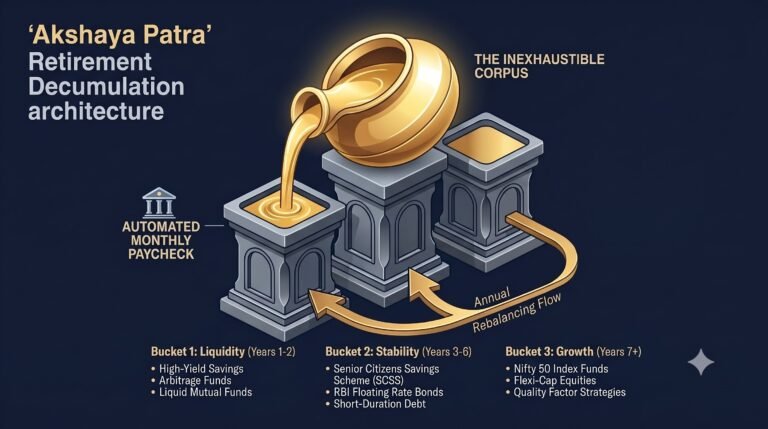
The Mythology of Inexhaustible Flow: In ancient Indian tradition, the Akshaya Patra (अक्षय पात्र) was a divine vessel that provided an unending supply of daily nourishment—never running dry because it was grounded in a higher structural order. Building a modern “Forever Paycheck” is the financial equivalent of engineering your own Akshaya Patra. By dividing your corpus into dedicated risk layers (Liquidity, Stability, and Growth), you ensure your monthly cash flow remains perpetual, granting yourself the behavioral permission to spend without fear of depleting your underlying capital.
The Decumulation Paradox: Why a Multi-Crore Corpus Fails to Buy Peace of Mind
Senior corporate leaders sitting on multi-crore portfolios often remain surprisingly hesitant to spend during retirement. Decades of operational habit train us to treat capital drawdown as structural failure. Every time someone withdraws funds for a family vacation or a major expense, loss aversion—the psychological asymmetry documented by Daniel Kahneman and Amos Tversky in their seminal research on Prospect Theory—kicks in.
This anxiety is compounded by Indian macroeconomic realities:
- Real Inflation Drag: Unlike developed markets where retirement models were engineered around 2% to 3% inflation, Indian retirees face long-term Consumer Price Index (CPI) inflation near 5% to 6%, with lifestyle and healthcare inflation compounding even higher. Official macroeconomic tracking by the Ministry of Statistics and Programme Implementation (MOSPI) and inflation targets set by the Reserve Bank of India (RBI) confirm that headline inflation targets demand conservative real-return assumptions for urban households.
- Sequence-of-Returns Risk: Experiencing a severe market drawdown in the first 3 to 5 years of retirement, combined with ongoing withdrawals, can permanently impair the compounding trajectory of your terminal wealth. Empirical research from the National Bureau of Economic Research (NBER) highlights how market timing early in decumulation permanently distorts capital preservation. Read my blog on Sequence of Returns Risk and it’s impact on the portfolio.
- The Death of the 4% Rule: Traditional thumb rules designed in the 1990s assume static withdrawal rates over 30 years. As Chatzky noted in her Morningstar interview, rigid withdrawal formulas are largely outdated. Fixed percentage rules fail to adapt to shifting interest rate cycles, volatile equity valuations tracked by the NSE India, and multi-decade longevity.
To overcome spending paralysis, high earners must engineer a system that replaces corporate cash flow with an automated, multi-tiered income engine.
Constructing the Indian “Forever Paycheck” Architecture
Treating retirement decumulation as an engineering problem requires dividing capital into two distinct operational layers: The Non-Negotiable Income Floor and The Inflation-Hedging Growth Engine.
The objective of the Income Floor is simple: cover 100% of fixed baseline expenses (housing, food, travel, utilities, insurance premiums) with low-volatility, guaranteed cash flows. Once baseline survival is mathematically secured, the remainder of a portfolio can remain invested in growth assets to fund discretionary lifestyle choices and combat long-term purchasing power erosion.
| Decumulation Layer | Primary Objective | Indian Financial Instruments | Structural Trade-offs |
| Tier 1: Non-Negotiable Income Floor | Cover essential living costs; eliminate sequence-of-returns risk on baseline survival. | Senior Citizens Savings Scheme (SCSS), RBI Floating Rate Savings Bonds (FRSB), Annuities, NPS Annuity payouts regulated by PFRDA. | Fully taxable at slab rates under CBDT rules; limited capital growth; locked-in yields. |
| Tier 2: Inflation-Hedging Growth Engine | Preserve long-term purchasing power; fund travel, hobbies, and legacy goals. | Flexi-Cap & Index Equity Mutual Funds, Dynamic Asset Allocation Funds, Arbitrage Funds registered under SEBI. | Subject to short-term market drawdowns; requires periodic rebalancing discipline. |
In the U.S., Social Security acts as a baseline safety net. In India, corporate leaders must engineer their own pseudo-pension. While annuities were historically viewed with skepticism due to low yields—a stance Chatzky admitted to holding early in her career before recognizing their risk-mitigation value—combining sovereign-backed tools like the RBI Floating Rate Bonds and SCSS allows Indian retirees to floor baseline costs securely.
Engineering the 3-Bucket Cash-Flow System
To operationalize the “Forever Paycheck” without locking an entire net worth into low-yielding insurance products, we can deploy a 3-Bucket Capital Model. This system decouples immediate monthly cash flow from short-term stock market volatility.
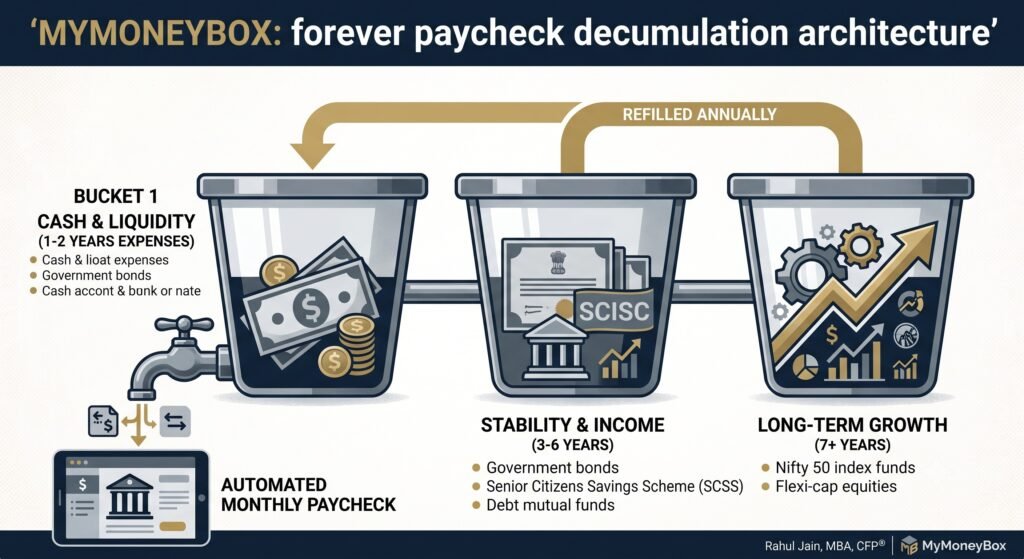
- Bucket 1: Immediate Liquidity (Years 1–2): Held in High-Yield Savings Accounts, Arbitrage Funds, or Liquid Mutual Funds monitored via the Association of Mutual Funds in India (AMFI). This bucket automatically transfers a fixed “paycheck” into an savings account on the 1st of every month. Knowing two years of living expenses sit safely in cash eliminates the urge to panic during market crashes.
- Bucket 2: Medium-Term Stability (Years 3–6): Composed of SCSS, RBI Savings Bonds, short-duration debt instruments, and Systematic Withdrawal Plans (SWPs) from conservative hybrid funds. Under current tax structures from the Income Tax Department (CBDT), SWPs from equity-oriented funds offer structural tax efficiency compared to fully taxable interest income.
- Bucket 3: Long-Term Growth (Years 7+): Allocated to broad-market index funds, flexi-cap equity funds, and quality factor strategies. Global macroeconomic indicators from the International Monetary Fund (IMF) and demographic trends compiled by the World Bank underline why equity exposure remains essential for emerging market investors. This bucket has a multi-year runway to navigate market drawdowns, compounding quietly to refill Buckets 1 and 2 during annual rebalancing.
Once a year, during a scheduled portfolio review, an investor harvests gains from Bucket 3 (if equities had a strong year) or draws down Bucket 2 to replenish Bucket 1. The daily noise of the stock ticker becomes irrelevant to a monthly lifestyle.
Behavioral Discipline: Granting Yourself Permission to Spend
Building a resilient decumulation framework is only half the battle; the harder half is behavioral.
High-earning executives rarely struggle in retirement due to a lack of initial capital. More often, they struggle because they permit financial anxiety to dictate their quality of life. Spending 40 years accumulating wealth for a future that is ultimately left unenjoyed happens when a balance sheet is treated like an untouchable museum exhibit.
Key Takeaway: Financial independence is not achieved when a portfolio reaches an arbitrary milestone number. It is achieved when a decumulation architecture generates predictable, automated cash flow—granting the structural freedom to spend capital on the life designed, without fear or friction.
By organizing capital into dedicated risk buckets and anchoring essential costs to sovereign-backed instruments, decumulation shifts from guesswork to systems thinking. Establishing this framework eliminates sequence-of-returns anxiety, protects purchasing power against Indian inflation, and turns an accumulated nest egg into a true Forever Paycheck.
To understand how these concepts build upon foundational habit-building and behavioral patience, explore our related pillars on Why Patience Matters in Personal Finance and the core framework behind Safe Withdrawal Rates in India. You can also read more about our systems-based educational methodology on the About Page and Author Profile.