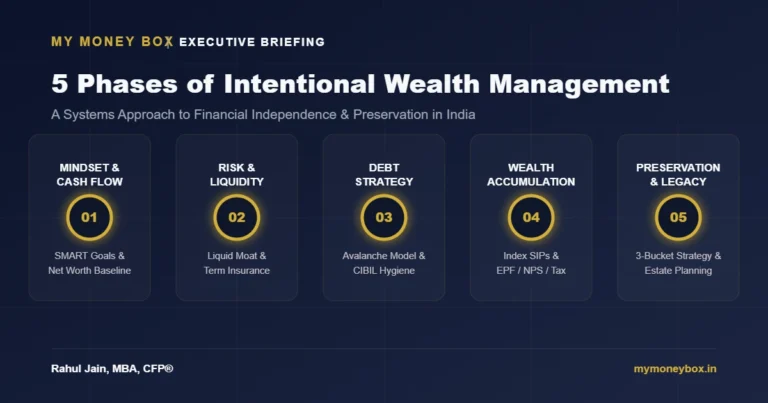
Thesis: Financial planning isn’t just for the wealthy; it is a dynamic roadmap that translates personal values into actionable financial moves.
Table of Contents
Over twenty-five years in corporate technology consulting taught me one fundamental rule about complex systems: unmanaged complexity degrades into chaos. Early in my career, I saw high earners—senior technology managers, enterprise architects, and executives—earning substantial incomes yet operating on financial infrastructure held together by duct tape. They mistook high corporate income for enduring wealth.
Executing a resilient financial planning framework in india executives can depend on requires moving past short-term market hype and establishing disciplined system design. Wealth is not income. Income is active cash flow; wealth is the resilient architecture you build with what remains. During my decade as a CFP®, I have viewed personal finance not as a series of speculative stock picks or market-timing hacks, but as a discipline of structural engineering.
A well-structured financial plan serves as a living operational framework—one that converts your core values into executable financial routines while protecting against inflation drag, market volatility, and longevity risk.
Key Framework: Financial planning is not a static document created once and filed away. It is an iterative, dynamic roadmap designed to maintain capital preservation and structural agility across every stage of life.
Phase 1: Financial Planning Framework in India – Mindset & Cash Flow Foundations
Defining SMART Financial Goals
A comprehensive financial planning framework in india professionals implement must begin with clear goal segmentation. Intentional capital allocation requires SMART goals categorized across three distinct time horizons:
- Short-Term (0–2 Years): Capital preservation is paramount. Focus areas include establishing an emergency reserve, funding an upcoming property down payment, or setting aside liquidity for advance tax or ESOP tax liabilities.
- Medium-Term (2–7 Years): Balancing capital preservation with inflation-adjusted growth. Focus areas include secondary higher education funds, sabbatical reserves, or mid-career venture capital deployment.
- Long-Term (7+ Years): Pure wealth compounding and retirement readiness. The target is establishing long-term independence where passive portfolio yield replaces active corporate income.
Cash Flow Optimization & Budgeting Architectures
You cannot manage what you do not measure. Optimizing cash flow requires auditing net income against total expenses to eliminate structural leakage. Three budgeting frameworks offer reliable structure depending on your behavioral profile:
- The 50/30/20 Rule: Allocates 50% of net income to Needs (housing, utilities, loan EMIs), 30% to Wants (lifestyle, travel), and 20% to Savings and Debt Acceleration.
- Zero-Based Budgeting: Every rupee of incoming income is assigned an explicit purpose—whether operational expense, investment allocation, or cash buffer—leaving zero unallocated margin at month-end.
- Pay-Yourself-First Framework: Automates Systematic Investment Plan (SIP) sweeps immediately upon salary credit, forcing operational spending to conform to residual cash balances.
Net Worth Tracking: The Baseline Scorecard
Your net worth is your personal balance sheet. Calculating it quarterly provides an unvarnished audit of your structural trajectory:
Net Worth = Total Assets - Total Liabilities
Track liquid assets (cash, mutual funds, direct equity, arbitrage funds), illiquid assets (real estate equity, primary residence valuation), and vested retirement reserves (EPF, NPS Tier-I) against outstanding liabilities (home loans, car loans, personal loans etc).
Phase 2: Risk Management & Liquidity
Sizing and Parking the Emergency Reserve
Before allocating capital toward growth assets, build a liquidity moat. An emergency fund prevents you from liquidating volatile equity investments during market downturns or sudden corporate restructurings.
- Sizing the Reserve: Maintain 3 to 6 months of baseline living expenses. High-earning corporate executives with concentrated income streams or single-income households should target 6 to 12 months.
- Capital Placement: For high earners in the 30% tax bracket, park liquidity in tax-efficient Arbitrage Funds, low-duration Liquid Mutual Funds, or high-yield savings sweep accounts. Avoid chasing yields at the cost of immediate liquidity.
The Insurance Protection Matrix
Insurance is a risk-transfer tool designed to shield your portfolio from catastrophic tail events regulated by IRDAI guidelines.
| Insurance Category | Primary Objective | Strategic Framework |
|---|---|---|
| Health Insurance | Shield against medical cost inflation | Comprehensive base family floater plan (₹10L–₹15L) paired with a high-deductible Super Top-Up (₹50L+). |
| Life Insurance | Replace lost human capital income | Pure Term Insurance covering 10–15x annual income until financially independent. Avoid traditional whole-life or ULIP plans. |
| Disability Insurance | Protect physical earning capacity | Personal Accident and Own-Occupation disability rider coverage to shield corporate earning capacity. |
| Property & Casualty | Protect physical capital assets | Fire, home structure, and contents insurance for residential real estate. |
| Umbrella / Personal Liability | Shield wealth from legal liability | Comprehensive liability coverage to protect high-net-worth professionals against third-party claims. |
Phase 3: Debt Strategy & Credit Health
Differentiating Good vs. Bad Debt
In financial planning (and elsewhere also), leverage is a double-edged sword:
- Bad Debt: High-interest credit card balances, consumer durables financing, and personal loans (18–36% Interest rates + Fees). These carry steep interest costs with zero tax benefits, creating severe compound drag on net worth.
- Good Debt: Low-cost, repo-linked home loans (~8–9% interest) used to acquire appreciating capital assets, particularly when leveraged alongside tax benefits.
Accelerated Debt Payoff Models
When systematically paying off debt balances, evaluate two established frameworks:
| Feature | Debt Avalanche Model | Debt Snowball Model |
|---|---|---|
| Core Mechanism | Target highest Interest rate debt first while paying minimums on others. | Target smallest total balance debt first regardless of Interest rates. |
| Primary Benefit | Mathematically Optimal: Minimizes cumulative interest expenses. | Psychologically Optimal: Builds momentum through quick structural wins. |
| Best Suited For | Analytical investors focused purely on total return optimization. | Individuals seeking behavioral motivation to maintain payoff discipline. |
Credit Score Hygiene (CIBIL)
Maintaining a strong CIBIL score (750+) reduces borrowing costs across your financial lifecycle:
- Payment History: Zero missed payments via automated credit card auto-debits.
- Credit Utilization Ratio: Maintain low total revolving utilization of overall credit limits.
- Age of Accounts: Preserve mature credit lines to maintain average account longevity.
Phase 4: Wealth Accumulation & Investment Strategy
Compounding Dynamics & Market Discipline
Attempting to time market cycles consistently degrades investor returns through emotional errors and transaction friction. Reinvesting compounding yields over multi-decade horizons generates non-linear growth that far outpaces short-term trading gains. As discussed in many blogs on this site of market timing and behavioral discipline, patience remains an investor’s greatest structural advantage.
Strategic Asset Allocation
Asset allocation—the proportional distribution between equities, fixed income, real estate (both in Domestic and International markets) and gold—drives over 90% of long-term portfolio return variability. Align allocations with your time horizon and risk tolerance:
- Equities (Growth Engine): Domestic exposure via Nifty 50, Nifty Next 50, and broad flexi-cap index funds to beat long-term inflation. International Exposure via appropriate UCITS (Undertakings for Collective Investment in Transferable Securities).
- Fixed Income (Volatility Anchor): Sovereign bond funds, Arbitrage Funds Corporate Bond funds, EPF, and PPF to stabilize cash flows.
- Real Assets & Alternatives: Sovereign Gold Bonds (SGBs), Real Estate Investment Trusts (REITs) and Infrastructure Investment Trust (InvIT).
Tax-Efficient Investing Architecture
Structure asset placement to minimize lifetime tax drag:
- Tax-Advantaged Retirement Vehicles: Maximize annual contributions across EPF, Voluntary Provident Fund (VPF), PPF (Section 80C), and NPS Tier-I (Section 80CCD(1B) / 80CCD(2)).
- Taxable Mutual Fund Brokerages: Utilize direct equity mutual funds for mid-term flexibility. Account for Long-Term Capital Gains tax (LTCG at 12.5% for gains above ₹1.25 lakh per financial year) and Short-Term Capital Gains tax (STCG at 20%).
Systematic Rule: Automate monthly SIP sweeps from primary salary accounts into low-cost index portfolios. Automating capital deployment eliminates human emotional bias and enforces systematic rupere-cost averaging through every market cycle.
Phase 5: Long-Term Preservation & Legacy
Retirement Targets & Safe Withdrawal Rates
Determining exit readiness requires calculating your target portfolio size based on expected annual expenses. While global literature highlights a 4% baseline rule, higher inflation rates in India require testing conservative withdrawal rates around 3.25%–3.5% (28x–30x annual expenses):
Target Financial Independence Corpus = Annual Living Expenses x 30
When transitioning from asset accumulation to active retirement decumulation, static withdrawal rates require careful modification to mitigate sequence-of-returns risk. Senior corporate leaders can explore how to structure automated distribution models in our dedicated guide on Designing a “Forever Paycheck”: Architecture for Retirement Decumulation in India.
Estate Planning Foundations
A complete financial plan extends beyond your lifetime. Estate architecture ensures smooth asset transition while minimizing legal friction:
- Registered Wills: Draft a clear, registered Will specifying legal heirs and distribution intent.
- Private Family Trusts: Establish family trusts for succession planning and asset protection across generations.
- Account Nominations & Joint Holdings: Audit nominations across bank accounts, demat accounts, mutual funds, and EPF annually. Note that nominations facilitate asset transfer but do not override the legal rights of heirs specified in a valid Will.
Conclusion & Strategic Action Plan
Financial planning is not a one-time exercise completed in a single weekend. It is a recurring operational process—an annual audit of assumptions, allocations, and risk coverage. Revisit your financial architecture every twelve months or immediately following major life transitions like career shifts, corporate restructuring, or family additions.
True financial security is not about achieving arbitrary wealth numbers or chasing market trends; as reflected in our discussion on Enough in Personal Finance, it is about securing financial peace and maintaining complete control over your time.
Your 3-Step Financial Checkup Action Plan:
- Audit Net Worth & Cash Flow: Calculate your net worth baseline and identify two unnecessary cash flow leaks this week.
- Verify Your Liquidity Moat: Ensure your emergency fund holds at least 3–6 months of expenses in dedicated liquid or arbitrage funds.
- Automate SIP Sweeps: Establish an automated recurring investment transfer to remove emotion from your long-term compounding strategy.
Take the Next Step in Your Wealth Journey:
Download our complimentary Comprehensive Financial Health Audit Checklist to evaluate your portfolio architecture.
Subscribe to the MyMoneyBox site for disciplined, analytical insights on wealth preservation, tax engineering, and long-term financial independence.